

Why we no longer place crowns on back teeth
Thu, 17th Sep 2026Historically a crown was the standard answer for a back tooth that was broken or heavily filled. It’s still what many people expect to hear when their tooth is badly damaged. At The Gentle Touch, we restore and protect teeth a better way – we use bonded onlays/ overlays!
What is a crown?
A crown is a cap that covers the whole visible part of the tooth, right down to the gum. To make room for it, the tooth is drilled down evenly all the way round to the gum, leaving a smaller core for the crown to sit on. The crown is then cemented into place.
What is an onlay?
An onlay is a tooth-coloured restoration that covers only the parts of the tooth that need it, usually the biting surface and any weak walls. It’s bonded to the tooth with modern adhesives, so the onlay and your tooth work together as one. Once in place, it feels, functions and looks like a healthy natural tooth.
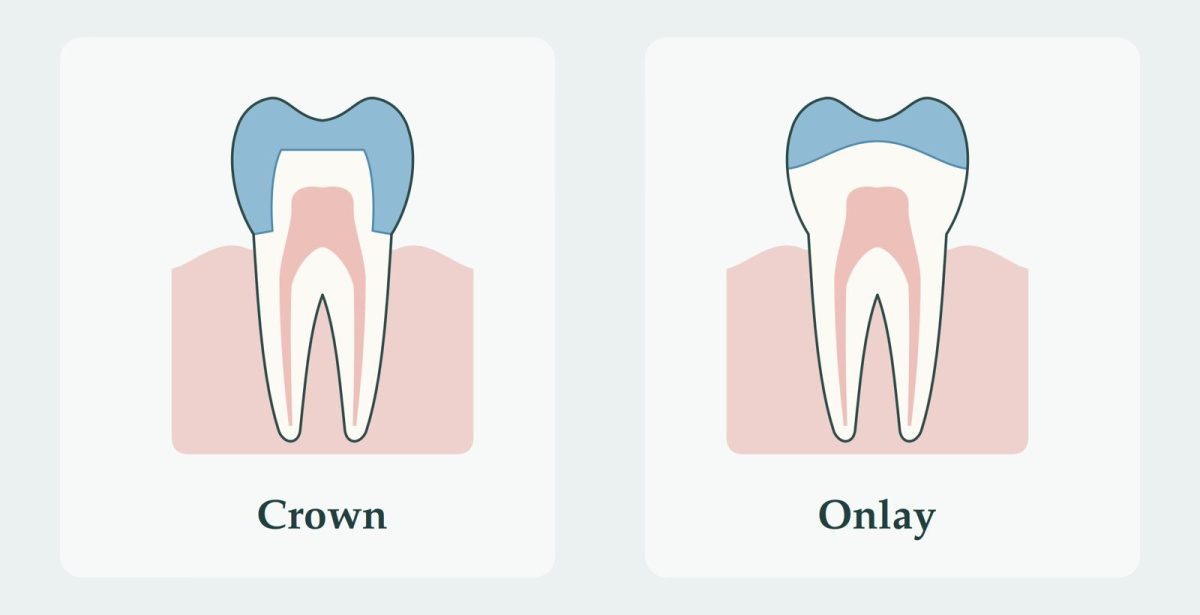
How they differ
Both can restore a damaged back tooth, but they go about it in very different ways.
- A crown removes far more tooth. Preparing a tooth for a crown often means taking away more than half of it, including parts that are perfectly healthy. An onlay replaces only what is weak or damaged.
- A crown relies mainly on its shape and cement to stay in place. An onlay is bonded to the tooth, which helps support weakened walls rather than simply covering them.
- The edges of a crown usually sit at or just under the gum, where they can be harder to clean. The edges of an onlay can usually sit above the gum, where they’re easier for you to clean and for us to check.
- Less drilling is kinder to the nerve. The more a tooth is drilled, the more stress the nerve inside is put under, and teeth prepared for crowns are more likely to need root canal treatment later on.
Do you ever use crowns?
Yes, in some situations. We may still recommend a crown for some front teeth, or when replacing a crown you already have. We’ll always explain why a particular option suits your tooth.
What if I already have crowns?
There’s no need to worry. Many crowns last well for years. We’ll review them at your check-ups, as we do with all your teeth, and let you know if anything needs attention.
Keeping more of your own tooth
Our approach rests on a simple idea: nothing works quite as well as your own natural tooth. Every decision we make aims to keep as much of it as possible, for as long as possible.
If you’d like to know whether an onlay might suit one of your heavily filled teeth, ask at your next visit or call us on 01573 224802.
Back to all news